

The £546m (and growing) question
BBC bosses believe getting more people to pay a smaller licence fee can save its future finances - do the numbers add up?

Welcome back to Whose Beeb?, a newsletter about the BBC Charter review and the future of public media.
In this issue:
The looming cliff edge for the BBC’s public funding, and why tinkering with the licence fee won’t avoid it.
The BBC’s gambit on cutting the licence fee, and the 6.6 million non-paying households needed just to keep Beeb finances standing still.
Plus new archive content from Demos, the Royal Society of Arts, and the BBC’s latest thematic review.
Look but don’t touch
One of the many frustrating and antidemocratic features of BBC Charter review is how frequently unnamed BBC execs or Government sources use the press to float their latest ideas for BBC reform.
This happened throughout the last review in 2015-16, when reliably anti-BBC papers amplified apocalyptic-sounding Tory proposals to “do away with highly commercial programmes” (£) or to scrap the licence fee altogether. Notably, many of these doomsday scenarios never went further than scare story headlines - or, at least in the case of ‘distinctiveness’ and market impact, came to pass in far more subdued and insidious ways.
What this does do, however, is create a kind of parallel, purely mediatised Charter review, with major questions about the BBC’s future played out in bombastic media coverage of elite discussions or ‘leaks’ of muscular posturing from either side, without any public input or debate.
It’s already happening for this current Charter review (as I wrote about in the last Whose Beeb?) and the recent Sunday Times article (£), under the headline “BBC considers return of radio levy to cut licence fee for all”, is only the latest manifestation of this typical Westminster-bubblefication of BBC policymaking.
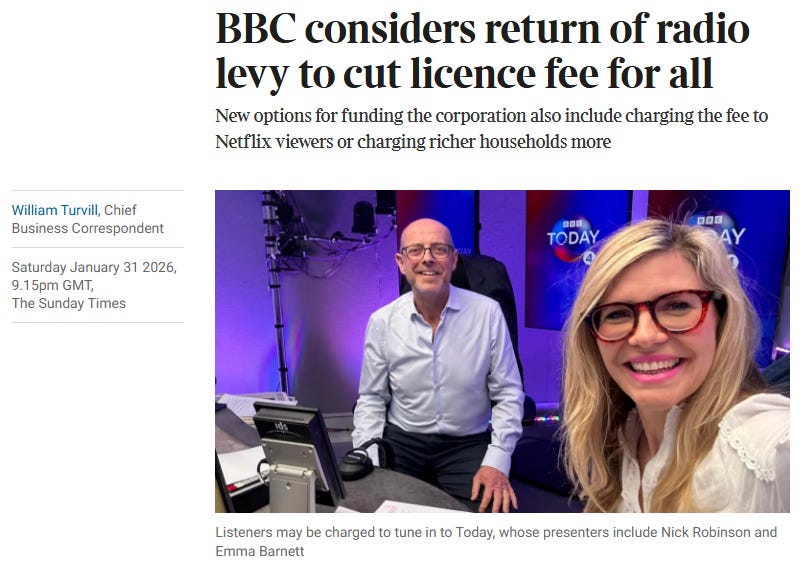
In the piece we’re told that “BBC bosses are considering a new way to fund the corporation, which would result in people having to pay the licence fee to listen to any of its radio channels or use its news website”. “The corporation’s leaders,” who of course go unnamed, are apparently preparing proposals to “cut or freeze the licence fee” by getting more non-paying households on the books.
Other ‘ideas’ (uncredited, and only vaguely attributed to actual internal discussions) include extending licence fee requirements beyond the current ‘any live broadcast or iPlayer’ definition to include e.g. the use of streaming services.
The article also hints at progressive rating of the licence fee, so that “wealthier households are charged more” - pitched on the zero-sum basis that “other families could then be charged a lower amount”.
Whether this is a BBC priority, or the preference of the Sunday Times, isn’t made clear. But just like the ‘less is better’ biases in the Government Green Paper’s funding proposals, the notion that the BBC’s public income might ever increase, not least to counteract 15+ years of freezes and cuts, never enters the discussion.
Taken together, the Sunday Times’ piece presents a messy grab-bag of possible funding reforms, all of which have been floating around debates on the future of the BBC and the licence fee for a decade and more.
If Board members are whispering these ideas around, it suggests that the BBC is not pursuing its previous support (e.g. 2024 and two weeks ago) for more radical progressive overhaul of the BBC’s public funding model - or, more likely, they see little prospect in this Government chancing more than tinkering at the edges.
And whether or not the BBC is putting serious thought behind offering a licence fee sacrifice (no doubt a sumptuous political prize for a Government that seems desperate to not mention Charter review at all), the underlying tone is clear: the BBC’s current public funding model is rapidly running out of road.
Smaller slices, shrinking pie
Two recent bits of news confirm the failed and faltering state of the licence fee. At the start of February, the Government announced an inflation-linked 3.1% increase in the cost of the licence fee for 2026/27, rising £5.50 to £180 for the year. Barely a week later, the BBC announced another round of 10% of cost-cutting. The approx. £33m gained from an increased licence fee will be immediately swallowed up by the BBC cutting hundreds of millions in expenditure.
This is, to put it lamely, A Bad Look™. Households are paying more (however ‘small’ or ‘good value’ an extra 46 pence a month may seem to BBC defenders) for a public service that is perpetually and visibly shrinking, with more skilled jobs and hours of programming lost.
The situation gets even worse when we consider the BBC’s collapsing base of public income, caused by a combination of rising licence fee evasion and people that simply don’t need to pay at all.
By 2030/31, licence fee evasion could cost the BBC almost £1 billion a year. By 2040, the combination of evaders and non-licensable households could mean that more than 50% of UK households will not be paying the licence fee.
To project how these trends may look up to 2040 (conceivably when the BBC’s next Royal Charter may expire), I had a play with figures from the BBC’s annual reports & its statements on TV licensing. Keeping in mind some of my quasi-scientific presumptions (e.g. UK household growth by ONS estimates), the picture for the BBC as a once-predominantly publicly-funded institution is bleak:
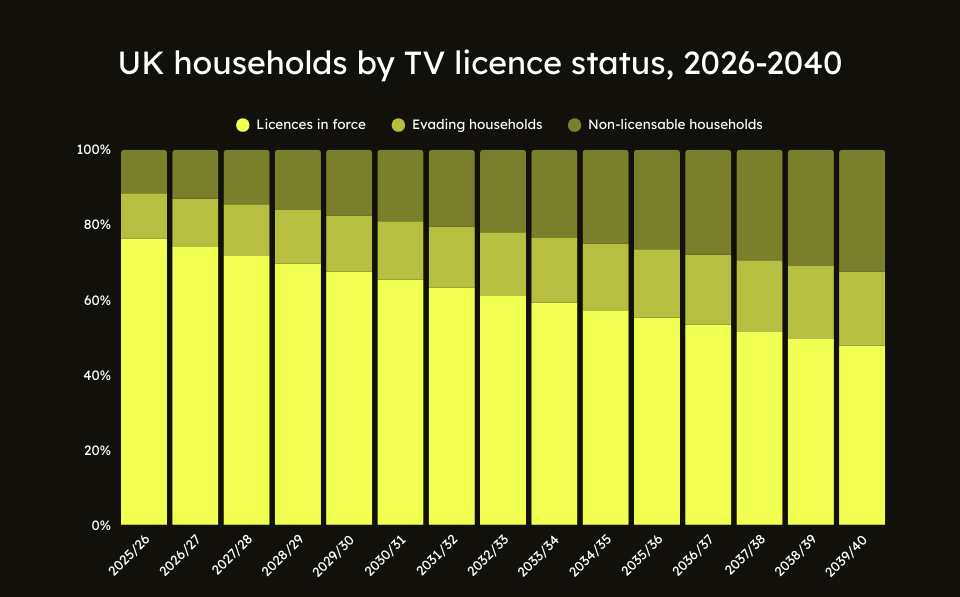
There are several things happening here, none of them good for the BBC or public media.
The first concerns the ROLC, or Reach of Licensable Content - the share of UK households that should pay the licence fee, because they watch live broadcast content or use BBC iPlayer. In 2024/25 the ROLC was calculated at just under 90%, on a slight drop from 2023/24, and it is widely expected to keep falling due to fewer people watching TV, fewer people watching the BBC, younger audiences preferring non-broadcast platforms, etc. etc. - and of course ability to pay guiding viewing choices.
Assuming that the fall in the ROLC continues by approx. -1.5% a year, the number of non-licensable households (the brownish bits on the chart above) will increase from 2.8 million today to 4.7 million by the start of the next BBC Charter - and to over 10 million by 2040.
The notion that, in just 15 years’ time, almost one-third of all UK households will have no interaction with live broadcast content or iPlayer is a seriously sobering prospect for the BBC’s legitimacy and appeal as a universal, national public broadcaster - not to mention the future of free-to-air (particularly DTTV) content.
Let’s make things even worse and add licence fee evasion to the mix, represented by the darker yellow bits on my graph.
The latest official estimate for the proportion of UK households that should pay the licence fee but don’t is 12.52%. This has been rising steadily over the last 5 years, for variously legitimate or politicised reasons I don’t need to spell out right now. In 2024/25 licence fee evasion cost the BBC £546m in ‘lost’ income - more than its yearly spend on BBC Two, Three, Four, News, CBBC and CBeebies combined.
If evasion continues to rise by an average 1.1% (and that feels like a modest estimate), the cliff edge of BBC funding very quickly comes into sharp view.
By 2030/31, licence fee evasion could cost the BBC almost £1 billion a year. By 2040, the combination of evaders and non-licensable households could mean that more than 50% of UK households will not be paying the licence fee.
Quick note: It’s entirely plausible that the ROLC has a ‘natural’ baseline (rather than constantly declining), because e.g. ‘older’ audiences that skew towards linear and BBC viewing are living longer. But equally, current evaders can very easily become avoiders, meaning that the combined share of non-payers would stay the same.
The ‘Do Nothing’ option
I should stress that these are very rough projections, based on basic presumptions about current trends - and I warmly welcome any messages or comments to point out glaring errors or omissions. I’m doing my best!
But to come back to the live question: would any of the options being debated or considered as part of Charter review make a serious impact on the BBC’s financial future?
Even if the licence fee were guaranteed yearly inflation-linked increases, this would leave the BBC with a stagnant public income of ~£4bn a year for the entire period of the next Royal Charter.
Let’s look first at the ‘Do Nothing’ option, in which there are no reforms to how the licence fee is collected or applied. This may seem unthinkable in the current climate, but it was also unthinkable for the last 20 years, during which the licence fee was widely and rightly regarded as a dead duck. That didn’t stop successive governments from skirting serious reform, and the options presented in the 2025 DCMS Green Paper lean heavily towards fewer people paying, rather than more…
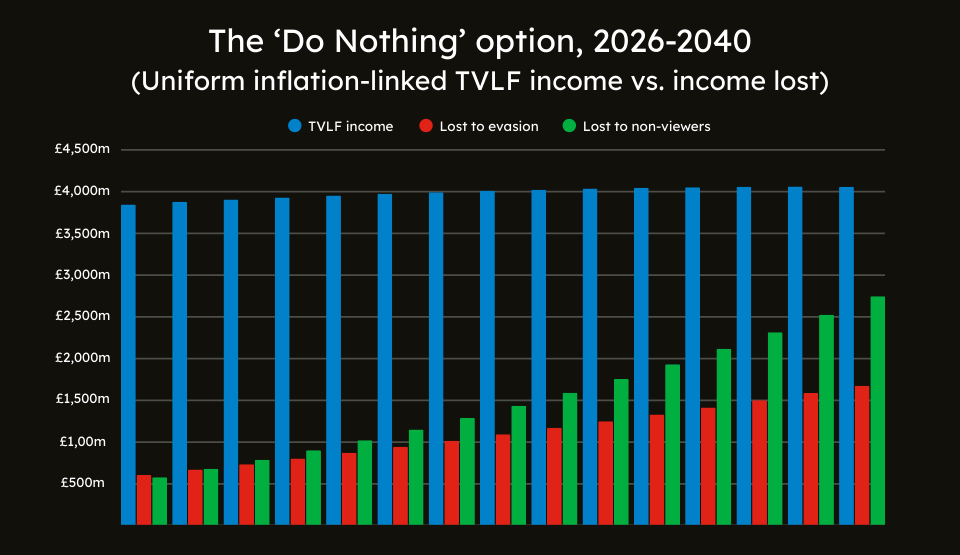
This graph assumes that the cost of the licence fee (£180 for 2026/27) will increase every year with a roughly applied 3% inflation - admittedly highly optimistic of me, from both an economic and political point of view.
As already detailed above, under a ‘Do Nothing’ scenario the number of UK households paying the licence fee could fall by as much as 30%, from 22.7 million today to 15.3 million by 2039/40.
Even if the licence fee were guaranteed yearly inflation-linked increases, this would leave the BBC with a stagnant public income of ~£4bn a year for the entire period of the next Royal Charter - in effect a real-terms funding cut against any cost increases.
BBC income lost to households evading licence fee payment could almost triple by the end of the next Charter period, from today’s £546m to £1.41bn. Income lost to both evasion and changing audience habits (i.e. non-licensable households) could rise from the current £1bn to over £4.4bn by 2039/40.
At this moment, with Charter review ongoing and actual avenues of reform stuck in limbo, this is the financial path the BBC is currently following.
The Technological Magic Wand
What if Lisa Nandy achieves the seemingly impossible, and concocts a new collection or enforcement regime to ensure that (some) licence fee evaders pay up?
Technological solutions - like requiring a unique BBC ID to enter and use iPlayer - have always run up against concerns about the impact on universal access and digital inclusion. It’s also true that not all evaders are doing so cynically - many are in desperate financial or personal circumstances, as shamefully regular cases of appalling prosecution and grossly unfair enforcement show.
But what if? Tackling even 25% of evasion (approx. 870,000 households this year) would immediately net the BBC around £150m, rising to a £420m funding boost by 2039/40.
Expanding the ROLC from its current ~90% to 95% provides a much larger initial £284m boost to the BBC - amounting to an inflation-busting 7% increase to its public income - rising to almost £400m by 2040 (providing for similar rates of rising evasion and continued audience shift away from whatever new conditions make up the presumed 95% ROLC).
Again these are best case scenarios with a lot of built-in assumptions, including sustained inflation-linked LF increases. I take for granted that any evading or non-licensable household brought under the new regime would be perfectly content to pay what’s owed, couldn’t find a way around the ‘magic wand’, and wouldn’t consciously alter their viewing habits to move outside of the licensable population. These are all big, possibly irreconcilable ifs.
Cutting the licence fee - is it worth it?
Lastly, I’ve tried to model the BBC’s plans for a cut to the licence fee, as reported by the Sunday Times. The unnamed execs seem to share with the Government’s Green Paper an apparent indifference for increasing the BBC’s income, so I’ve taken as my ‘target’ the BBC’s current level of public funding (plus yearly 3% inflation).
For a household saving of £3 a month, the BBC would need to immediately attract or compel 6.6m additional fee-paying households just to keep its public income stable.
If a new collection regime cut evasion by 25%, the licence fee could be cut from £180 a year to £175.39 (a household saving of £4.61 or 38p a month).
Cutting evasion to 50% would enable a licence fee cut of £11.59 (97p a month), reducing the cost from £180 a year to £168.51.
In both scenarios, the value of the licence fee would still need to increase by between £4 and £5 a year to keep the BBC’s overall (nominal) public income at a stable (effectively stagnant) level.
Taking the licence fee back to its 2025/26 cost, while requiring nearly 2 million currently-evading households to cough up, doesn’t sound like much of a political and policy victory that will echo down the ages.
How about expanding the ROLC by including other media formats in the licensable conditions? Let’s go with 95% as a new base, again assuming that audience ‘drop-off’ and evasion would still increase on current trends. This would allow you to cut the licence fee to £166.84 - a marginally meatier saving of £13.16 or £1.10 - though would still require regular inflation-linked top-ups.
What if instead the Culture Secretary wanted to ‘go big’, and declared she wanted to save BBC audiences 20% on their licence fee costs (from £180 to £144) - while still living up to the Green Paper’s ambition of “sustainable long-term funding”?
For a household saving of £3 a month, the BBC would need to immediately attract or compel 6.6m additional fee-paying households just to keep its public income stable.
This is equivalent to ‘capturing’ 80% of all households that are currently either evading the licence fee or not falling under the licensable conditions, and could not be achieved by eliminating evasion alone.
Ultimately, all questions about how the BBC is funded have to reckon with the other central pillar of Charter review - what kind of public service and cultural institution licence fee payers get in return for their money. No Government will ever ‘fix’ the BBC’s funding without a fundamental examination of what the BBC is for as a public and democratic intervention in the media landscape - something that is sorely lacking from the Government’s Green Paper.
The Government’s chosen ‘solution’, likely to be pre-agreed in murky horse-trading with BBC execs, may be having more people pay less, or fewer people pay more. But it is completely unfeasible that any reforms to BBC funding - at this moment of extreme political polarisation, distrust in institutions and direct attacks on the BBC itself - will earn any support or compliance unless the public gets something substantial back in return.
What that might look like… is a topic for another issue. Thanks for reading!
Excellent article, it really shows the financial cliff the Beeb is facing. Keeping the licence fee is really just a slow death, it simply can’t stay. But the question really is how do you fund it?
If it runs adverts, then ITV/C4/C5 likely collapse. It could go into general taxation, but let’s be honest, that just means constant cuts. It could try subscriptions, but that goes against "free for all," so you're left, I think, with two options:
1) It moves to the council tax: More progressive, but it would be attached to the second most unpopular tax in the UK after the licence fee.
2) You move it to broadband and mobiles: Probably a £3 or so monthly levy could cover this—most would pay less than they do now.
I think option 2 is the only way to do this. You could bring it in at, say, 50p, call it some random name like culture levy, and not link it to the BBC, but put the cash in a "culture fund." Then, every year, increase it in line with when broadband suppliers already increase fees. In five years, you could get it up to £3 and no one would notice.
Then you announce the licence fee is scrapped and say it's being paid for by this fund. No one would really know or care because they would be used to paying the levy.
At the same time, you get hold of BBC Studios and give them a very strict target of growing BritBox to 10 million subscribers in 4 years, 15 million in 8 years, and 20 million in 10 years—there is no reason that can't be done.
They have 4 million subscribers now, but it only shows dramas and is only available in 4 countries! Just adding News, kids' shows, and Doctor Who would increase the subscriptions. Plus, the BBC knows at least 6 million people in places like Spain and Dubai access iPlayer without really paying. Once you get BritBox to the 20 million mark, we’ll start to see a flywheel effect happening, and the BBC will slowly become more self-funding.